
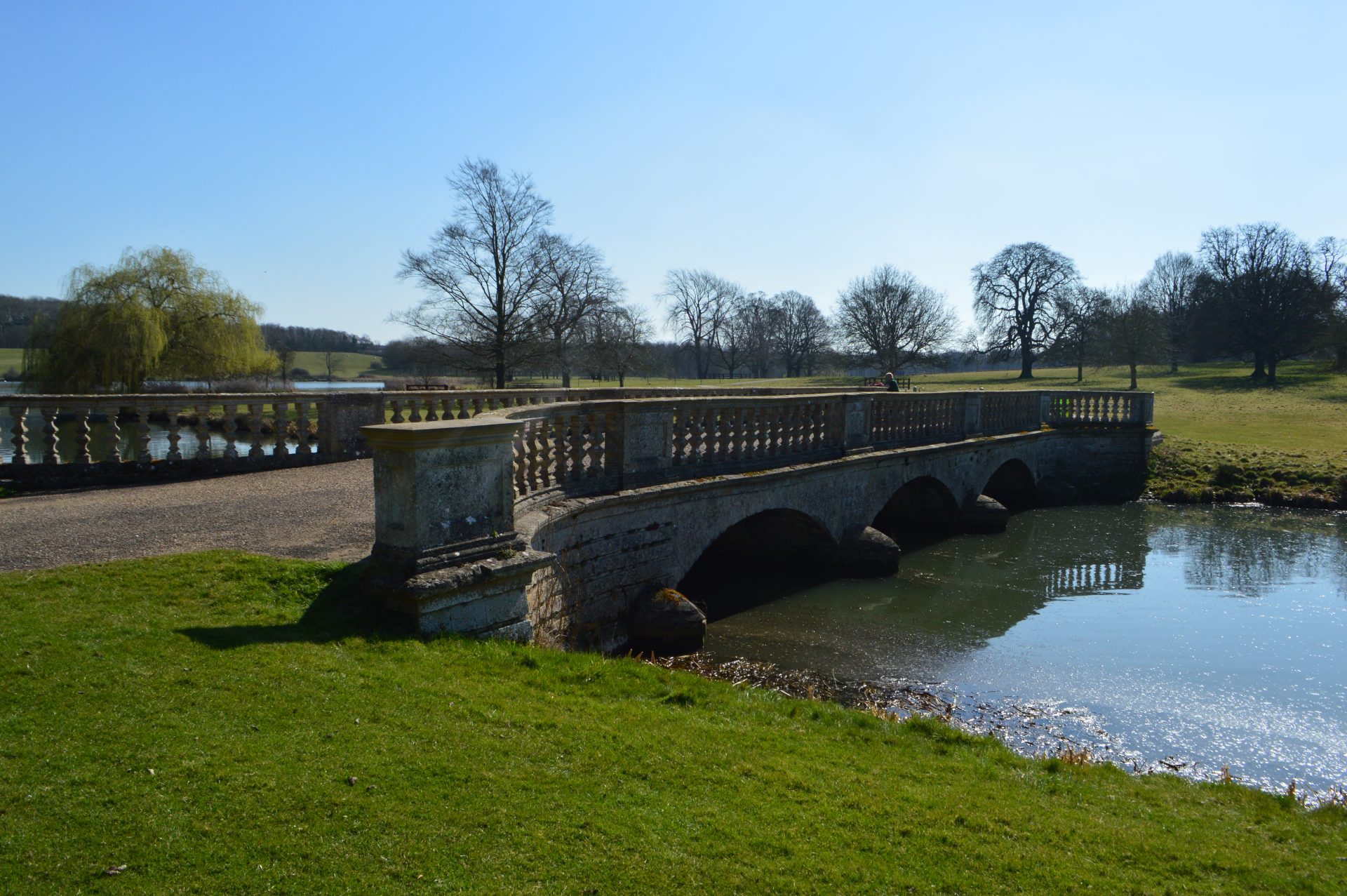
Deene Park Stone Bridge, Corby
Heritage Structural Assessment and Load Certification of a Grade II Listed Masonry Arch Bridge
- Client: RAM Services Ltd
- Asset Owner: Deene Park Estate (Brudenell Estates)
- Architect / Principal Designer: Corporate Architecture Ltd
- Location: Deene Park Estate, Corby, Northamptonshire, spanning Willow Brook
- Heritage & Regulatory: Grade II listed structure; Environment Agency (Willow Brook, a main river, Flood Zone 3); Local Planning Authority, Heritage and Conservation Officer
- Services Provided: Structural Dilapidation Survey and Report; Masonry Arch Structural Analysis (LimitState:RING); Post-Maintenance Structural Appraisal; Permissible Load Determination; Heritage and Environmental Compliance Support; Maintenance and Access Strategy
PROJECT SUMMARY
Countywide Consulting Engineers were appointed by a specialist repair and maintenance contractor to assess a Grade II listed eighteenth-century masonry arch bridge at Deene Park Estate that had fallen into disrepair and been restricted to pedestrian use. Working to a tight, wedding-driven programme, Countywide surveyed the undocumented structure, developed a heritage-sensitive repair strategy, worked closely with the Environment Agency and conservation officer to facilitate the repairs in accordance with statutory requirements, and used specialist masonry arch analysis software to establish a safe and conservative load limit, ultimately returning the landmark structure to certified use.
ISSUE
Deene Park, near Corby, has been the seat of the Brudenell family for more than five hundred years: a Grade I listed house set within registered parkland of special historic interest. At the narrowest point of the lake that fronts the house stands its iconic stone bridge, an eighteenth-century masonry arch built in part from the balustrade of the estate’s old chapel. It is far more than an ornament. It carries the main approach to the house, it is the favourite setting for wedding couples to be photographed, and it has appeared on screen, most recently in the film Saltburn.
The bridge had also been deteriorating, quietly, for a very long time. It spans Willow Brook, a main tributary of the River Nene, in an area of significant flood risk and, after more than two centuries without any recorded inspection or maintenance regime, the effects had steadily accumulated within the masonry arch structure. A review by the estate’s architect found the bridge to be in poor condition and recommended that it be restricted to pedestrian use, with vehicular access withdrawn until its structural integrity could be properly assessed.
That created a real problem, because a high-profile private wedding had already been booked on a date that could not move, at which a horse-drawn carriage was to cross the bridge to the house for photographs. A pedestrian-only restriction would have prevented it. Repairing a listed structure over a main river is also not a matter of simply sending in a contractor. Heritage considerations, Environment Agency permitting requirements and conservation oversight all had to be carefully managed, and any one of them, handled improperly, could have resulted in delays running well past the wedding date. The bridge needed to be understood, repaired and proven safe, correctly and quickly.
SOLUTION
This project brought together several areas of Countywide’s expertise: structural assessment, heritage engineering and practical problem solving, where structural engineering, heritage legislation and an immovable deadline meet. Rather than take an undocumented structure at face value, we began with a full dilapidation survey, inspecting the arch barrels at close quarters from the water beneath both spans, and set out the bridge’s true condition and the case for repair in a first report.
Because we understand how the legislation around listed structures and main rivers work, we were able to guide the project through it without losing time. Working with the local authority conservation officer and the Environment Agency from the outset, we agreed an approach driven by appropriate, sympathetic repair methods, which allowed the works to proceed correctly without the long delay of a full Listed Building Consent application. The remediation, carried out by the contractor from a pontoon, used hydraulic lime repointing, carefully supervised grouting of internal voids and like-for-like replacement of missing brickwork, all in keeping with the original construction. The one modern material, an internal grout, sat entirely within the structure with no effect on its appearance, satisfying the requirement to preserve the bridge’s character.
The method also satisfied the Environment Agency. By containing the works over the water, protecting the brook against any material falling into it and carrying out the repairs during the lower-water months, we helped secure the environmental permit and gave the Agency sufficient confidence in the method that they did not need to attend and monitor the works. The water quality and wildlife of a protected watercourse were safeguarded throughout the maintenance programme.
OUTCOME
With the repairs complete, we returned to model the bridge in its improved state. Using LimitState:RING, the most up to date software for masonry arch analysis, we assessed the repaired structure in three dimensions under worst-case load positions. The analysis showed the bridge would reach critical failure at around sixteen tonnes. Rather than certify it anywhere near that limit, we set a permissible load of 7.5 tonnes, comfortably less than half the failure load, together with a low-speed restriction. On a fragile listed structure in a flood zone, that deliberately large margin is the point: it protects the bridge from the very stresses that have damaged it and gives it decades of safe life rather than a return to decline.
A certified safe load of 7.5 tonnes sits well above the weight of a horse-drawn carriage. The wedding went ahead on schedule, the carriage crossed to the house as planned, and a bridge that weeks earlier had been considered for decommissioning was instead repaired, recertified and returned to use. To keep heavy loads off the structure for the longer term, we also recommended that service and emergency vehicles use the estate’s alternative rear access (although much less picturesque).
The wider result matters as much as the wedding. The bridge’s appearance and structural integrity were preserved, and every authority responsible for protecting it, the conservation officer, the Environment Agency and building control, was satisfied with how the work was carried out. A structure that had gone two hundred years without a single record now has a documented condition baseline, a permissible load and a maintenance strategy to guide its future inspections. A listed landmark that frames the estate’s weddings and has featured on screen has been kept safely in service for the generations who will cross it next.
Anyone can close a bridge and call it safe. The real skill lies in understanding a historic structure, preserving its character, satisfying the authorities responsible for protecting it and returning it to safe service for future generations.