
DUKE STREET EV CHARGING HUB, GLASGOW
Unlocking a World-First Solar Canopy EV Charging Development
- Client: SERCONNECT Ltd
- End Client: Osprey Charging Network
- Project Partners: Re-Power Energy, Galliford Try
- Location: Duke Street, Glasgow
- Services Provided: Preliminary Risk Assessment, Geotechnical Evaluation, Site Investigation, Non-Destructive and Destructive Testing, Structural Assessment, and Civil & Structural Engineering Consultancy
PROJECT SUMMARY
Countywide Consulting Engineers were appointed by SERCONNECT Ltd to investigate complex ground conditions beneath a pioneering solar EV charging hub in Glasgow. Through targeted site investigation, geotechnical assessment and structural appraisal, we helped de-risk the development and support the delivery of a world-first renewable energy infrastructure project.
ISSUE
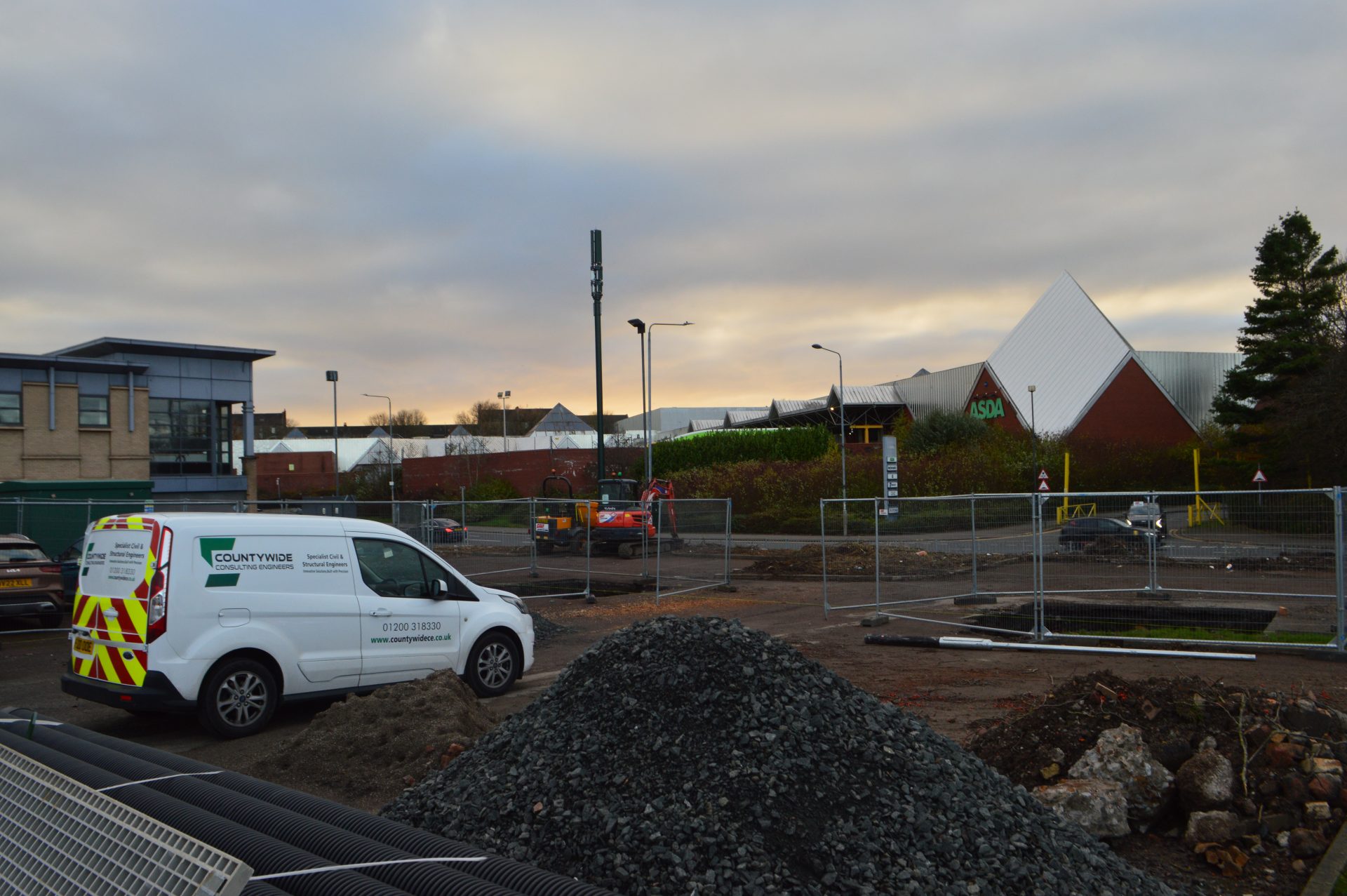
On a patch of old wasteland beside a busy shopping centre on Duke Street, in Glasgow’s East End, something genuinely exciting was taking shape: a rapid and ultra-rapid electric vehicle charging hub, the first of its kind anywhere in the world. Not the usual steel frame with a few panels bolted on, but a sculpted, moulded photovoltaic canopy, a design Osprey Charging, Re-Power Energy and Galliford Try intended to serve as both a flagship and a blueprint. Twelve charge points with room for more, dropped into a neighbourhood being brought back to life, where a community was crying out for somewhere to charge while they shopped. Prove it here, the thinking went, and the same model could roll out right across the country.
That was the promise. The challenge was everything the promise was about to be built on.
This is a site with a long and tangled past. It sits over the Camlachie Burn, a watercourse that once drove the mills and works of industrial Glasgow before being culverted and quietly buried beneath generations of development. Every era left something of itself behind, deep in the ground, and almost none of it was fully documented. On paper, the picture looked manageable: records identified an old masonry culvert associated with the Burn, and the foundation design assumed the ground would be capable of supporting the proposed canopy structure.
The snag was that all of this was theory, drawn from historical information rather than a detailed understanding of what was actually present beneath the site. As construction planning advanced, questions emerged regarding the true condition of the ground and the suitability of the proposed foundation solution. With a critical grid connection deadline approaching and a pioneering piece of infrastructure relying on a successful outcome, obtaining certainty became increasingly important.
It is the kind of challenge that does not reveal its true nature from the surface. Read quickly, it was simply a case of “checking the ground”. Read properly, it was a much bigger question: could a world-first piece of green infrastructure, with national rollout potential, be confidently delivered on a complex Victorian brownfield site without extensive redesign or unnecessary delay?
SOLUTION
That’s where we came in, appointed by SERCONNECT, the firm delivering the civils and high-voltage package. This is exactly our kind of work: civil engineering at the sharp end of innovation. Rather than relying solely on historical records and inherited assumptions, we went looking for answers where they actually live: in the history of the site and in the ground itself.
The desk study came first. We reviewed available records, pieced together the site’s industrial history and paid close attention to the details that did not quite align. The documentation suggested one picture, but experience told us there was more to uncover. That closer review identified a culvert running directly beneath the proposed canopy footprint, exactly the type of buried feature capable of influencing a foundation design.
This is where investigation becomes engineering. We do not simply identify potential constraints; we work to understand them and develop practical solutions. Across three targeted trial excavations, the picture began to emerge. We uncovered the arched brickwork of the former culvert, which had been partially demolished, backfilled and capped, alongside a smaller modern pipe that had replaced its function and sat clear of the proposed foundation locations.
Then, directly beneath one of the proposed canopy supports, we discovered something that was not shown on any available records: a substantial concrete slab associated with a long-forgotten basement structure. What initially appeared to be an obstacle became another engineering question requiring evidence-based assessment.
To establish the suitability of the slab and underlying ground conditions, we appointed our specialist contractor partner to obtain concrete core samples for testing through our UKAS-accredited laboratory partner. Further Dynamic Cone Penetrometer (DCP) testing was undertaken to assess the strength and bearing characteristics of the underlying ground. Together, these investigations provided the information needed to move from uncertainty to confidence and develop a practical foundation solution.
OUTCOME
The results told a far clearer story than the assumptions ever could. Where the original design had adopted an assumed bearing capacity of 100 kN/m2, the ground proved capable of supporting approximately 514 kN/m2, more than five times the original assumption. And that mystery slab? Rather than becoming a costly obstacle, the testing demonstrated it provided a stable and suitable foundation platform, requiring only a modest design adjustment to integrate it into the final solution.
The benefits were significant. Rather than requiring extensive redesign or alternative foundation solutions, the canopy could be founded largely as intended, with only minor modifications. The first phase of our work was completed in December, enabling the project team to secure the critical grid connection before the cut-off date and maintain programme momentum. The full investigation and revised design solution were completed within a matter of months, allowing the wider project team to proceed with confidence.
Perhaps most importantly, uncertainty was replaced with evidence. By establishing a clear understanding of the site’s subsurface conditions, informed decisions could be made across the project team and construction could progress with confidence.
The bigger picture is the prize of a national roll-out. A world-first solar charging hub was successfully delivered. Clean, sustainable charging infrastructure for a corner of Glasgow being brought back to life, providing drivers with a convenient place to charge while they shop, and creating a proven blueprint that Osprey and Re-Power can now take to sites across the country.
None of that happens if the ground beneath a site remains a mystery. Anyone can measure a patch of ground and make assumptions; the real skill is knowing what its past is hiding, what it can genuinely carry, and how to prove it when an entire project depends on the answer. That, in the end, is the difference between checking a number and truly understanding a site.